Bee Benefactor Update 28/01/16

I would like to introduce the Bee Benefactor Update series to the blog. The post will be an update of how my hives are going, any upcoming events, and any interesting information which I find which is too small for its own update. If you have any bee related news or local events you wish to promote, feel free to email me at beebenefactor@gmail.com.

New Blog

You may (or may not) have realised that the Bee Benefactor Blog has successfully transitioned to a WordPress.com blog (from blog.com). During the next few weeks you may notice some style changes as I experiment with the new format. I encourage you to let me know what you think of the new style, and to “follow” the blog if you want to keep up to date with that is happening on the blog. A very exciting time indeed!

New Swarm

After what has been quite a productive season for my hives, my “main colony” in by backyard apiary decided it was time to swarm. They chose a tall “Sheena’s Gold” tree (Duranta erecta) in my yard, which is very interesting as approximately 80% of the wild swarms I get called to tend to be resting in a Duranta erecta style of tree, which if I was forced to speculate I imagine may be due to the large amount of foliage cover and intersecting branches providing both concealment and support to the swarm. After quickly and letting the swarm fall into a metal trashcan I had handy, I simply walked a few metres to an empty top bar hive and poured the bees in. I had two or three top bars coated with wax, and a block of solidified sugar in the hive which immediately got their attention. I actually found that this swarm collection was the easiest I have ever conducted, and the bees have already started constructing comb. This was only three weeks after I conducted a split on the original hive, and the fact that all three hives are seeming to do well leads me to speculate that the food sources in my area (South side of Brisbane, QLD) must be plentiful at the moment.

New beetle trap 
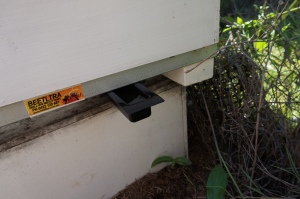
The Beetltra trap being removed from the side of the hive.

The Beetltra trap being removed from the side of the hive bottom board. .

Like most places in Australia, my hives have to contend with African Small Hive Beetle (SHB), which are in no short supply at the moment. I decided to try a new style of bottom board SHB trap; the Beetlra. I conducted a split of my strongest hive and put the split on to a Beetlra 10 frame with cleats. It is in week three of its operation, and after checking the trap every seven or eight days, I have found that the trap usually has a minimum of five beetles, and has had a maximum catch of 15 so far. I am stocking the trap with a mixture of vegetable oil (to drown the beetles) and apple cider vinegar (to attract the beetles), however this is against the manufacturer’s advice (they say that Agricultural Lime is the better option, as oil mixtures can clog up the the operation of the Beetltra). I have also heard of people using food grade diatomaceous earth to destroy beetles.

New Hive

As mentioned above, the new swarm has conveniently allowed me to stock my newly created Kenyan Top Bar Hive (KTBH). Whilst I have experimented with top bars in the past, this is my first committed attempt to start an apiary with both top bar and Langstroth hives. I will try to keep you all informed as to how the KTBH goes, especially when compared to the Langstroth hives.

Sign Off

That is all from me for this week. Let me know in the comments if you have collected any swarms recently, or whether you have used the Beetltra with any success.

Regards,

The Bee Benefactor.


The Flow Hive still requires a lot of work

For the two of you out there who do not know, the Flow Hive is an ingenious invention which was successfully crowd funded  with over $12 million pledged to the project. Furthermore, the technology is Aussie grown, with Cedar Anderson and his small team going through years of careful development in the laid back surrounds of Byron Bay.

I have no problem with the Flow Hive

The Flow Hive is very clever. It makes the process of harvesting honey a lot quicker and more accessible to people from many backgrounds, including those with mobility and strength issues which prevent lifting supers, and working from above a hive. The Flow Hive team themselves seem to preach a “natural-lite” beekeeping style, emphasising the importance of letting bees form their own comb, and limiting the use of pesticides and chemicals inside of the hive. They have also started to release a series of videos which look very promising and (are so far) simple and easy to follow. Overall, I have no real issue with the Flow Hive, or its inventors. Conversely, I find that the Flow Hive has captured the imaginations of the public (internationally) and anything which brings bees and beekeeping into the public eye I find are usually beneficial to the bees.

My problem is with the attitude of new beekeepers

I certainly do not want to be the one to kill any new beekeeper’s enthusiasm, but I feel that I need to conduct a few reality checks to save some heartache and disappointment later down the line. I will briefly write about some of the realities which beekeeping rookies may have overlooked (or ignored) when deciding to start beekeeping with a Flow Hive. Continue reading

Opening your hive is killing its productivity

One of the first concepts I learnt when hearing about apicentric beekeeping was the concept of “hive atmosphere” and its vital role in colony health. Hive atmosphere describes the ideal conditions inside of the hive, and takes into consideration the temperature, humidity and other environmental factors at which the honey bee hive smoothly operates at. Brood seems to develop in the hive most effectively at 32°C (and Queen cells at 35°C) at a humidity between 50% and 60%. This implies that in warmer months, bees must expend energy to fan the hive and initiate evaporative cooling techniques, and in the cooler months generating heat using their wing muscles. Even in Brisbane, which is relatively free from blistering hot summers and snowcapped winters, the first twelve days of 2016 have yielded a range of 18.5°C minimum and 32°C maximum temperatures, with 41% minimum  and 95% maximum relative humidity. This is before you even take the many various pheromones and vibrations the bees use to regulate their internal operations and efficiency. For the bees to maintain constant hive atmosphere, the hive has to expend a lot of time and energy.

How this should influence the beekeeper

A beekeeper should consider that every time they open their hive, they are releasing the hive atmosphere that the bees have created, and therefore negatively impacting the health of the hive. Even if you are not an apicentric beekeeper, the concept is quite simple: every time you open your hive, the bees need to burn energy (see: honey) to return the hive atmosphere back to optimal levels. You, as the guardian of these creatures, should take it as a personal mission to help the bees maintain these conditions, which you can do using a few of the following practices. Continue reading

Beekeeping FAQs – The most common questions I get asked

I decided to go on a voyage of self reflection and ponder the most common questions I am asked as a beekeeper, and construct answers which would not only allow me to better understand people’s curiosity (and fears) associated with bees, but also potentially teach some people who may stumble upon this page a thing or two about bees. I will update this post from time to time, if I find a different question keeps popping up, but ultimately this is aimed at people unfamiliar with bees or beekeeping. If you are a beekeeper yourself and wish to contribute, or have a question which is not answered here, please shoot me an email at beebenefactor@gmail.com. Continue reading

Gardeners are more important to bees than Beekeepers

The following is an opinion piece, designed to promote discussion and thought about helping all bees (not simply Apis Mellifera). If you are offended by this article, I would encourage you to take part in the discussion, but please keep in mind that people of all ages may access this site, and aggressive or harassing behavior will not be allowed. If you have any submissions, please feel free to contact me at beebenefactor@gmail.com.

Bees are very interesting creatures. There are literally tens of thousands of types (in the vicinity of 19,200 globally) that we know of, which means that there are more types of bee than there are mammals and birds COMBINED. In Australia alone, we have over 1,500 known species, including the increasingly popular (and increasingly endangered) stingless varieties (e.g. Tetragonula carbonaria) of which there are 10 known varieties. Bees have multiple ways that the harvest pollen and nectar, with some using very long tongues to reach into deep flowers (like the Amegilla bombiformis aka the Teddy Bear Bee), others (like the Amegilla cingulata aka the Blue Banded Bee) use a technique called “buzz pollination” to vibrate a flower causing pollen to fall off onto the bee. Fascinating as these methods are, the implication is that multiple bees require multiple types of flowers. Continue reading

Pyrethroids, Pyrethrins & Pyrethrums – Insecticide Profile

The following is a guide written to assist people who are looking to find out more about pesticides and their effects on bees. This should be used as generic educational advice only and does not alter your obligation to follow local laws and rules, on top of safety requirements relating to the application of insecticides. If you have any submissions to add to this post, or requests to amend its contents, please email me at beebenefactor@gmail.com. Continue reading