You may have just had an awkward conversation with a neighbour as they bashfully announced they keep honeybees in their yard, or worse you peeked over your fence and witnessed a box buzzing with little stinging, killing machines! The horror! What ever will you do?
I am here to tell you that everything will be fine…
As an overall message, I would try to establish an open dialogue with your beekeeping neighbour. They are usually more than happy to talk about their bees, and often will try to do things to alleviate any concerns you might have. Remember, your neighbour has likely put countless hours of work (not to mention a fair amount of money) into starting and maintaining their hive, so it is difficult for them to justify completely getting rid of their bees. The most important thing is to ask for your neighbour’s emergency contact details, in case you need to tell them if something is happening with their bees.
This article will hopefully give you some information and context as to why your neighbour is keeping bees, how you can help the bees out, and what to do if you have questions or requests regarding the bees and their hive.
Why is my neighbour keeping bees?
Short answer: Normally, they love honey, bees, the environment or their garden (exceptions apply).
It is difficult to speak for every beekeeper, as there are many motivations for wanting to keep bees. The most obvious reason is that people want to collect honey, and this is generally one of the more common reasons people have to keep bees. I personally keep bees because I have almost always been completely fascinated by them and am concerned about their declining numbers worldwide. Others I know do it to harvest other bee products, like wax, propolis, pollen, or pollinate their gardens (or farmland). Some people like keeping or helping local species of native bees by providing a home for them, and keep them as a way to prevent their extinction.
What type of bees does my neighbour have?
Short Answer: Probably Apis Mellifera (European Honeybee). But it can depend on where you live.
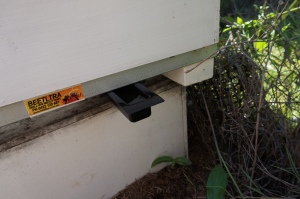
It is important that you do not assume anything. There are approximately 20,000 species of bees globally, and a number of those bees are social (and have hives or nests). The most commonly kept bee (especially in “Western” countries) is Apis Mellifera or the “European Honeybee.” The major reason they are so popular is that they produce a lot of honey, and possesses traits which make them relatively easy to control and multiply. Apis Mellifera are most commonly kept in “Langstroth Hives” (with some exceptions, depending on the host country) which consist of stack (usually 2-3) of boxes roughly 30cm x 50cm and 25cm high, however there are many configurations and variations on this size. There are multiple “strains” of Apis Mellifera which can slightly change the size and colour of the bees (e.g. Caucasian honeybees are usually very dark, whereas Italian honeybees have the golden stripes most people are familiar with).
If you look over the fence and see a box which is about the size of a basketball or a large shoebox (i.e. not very big) it is likely that your neighbour is keeping stingless bees, which are likely to be native to your area (e.g. Tetragonula Carbonaria in Northern parts of Australia). These bees are normally very small, and can be confused at a distance with little flies. Stingless bees are also very important to the environment, and will not likely cause you any issues at all, as they cannot sting (thus the name), and generally have smaller populations than honeybees.
If you live in a country like Japan, you may have a neighbour with Asian Honey Bee hives (Apis cerana). This type of bee is commonly viewed as a pest in non-Asian countries (especially Australia), as the bees are not seen to be as productive as their European counterparts, and carry some pests (like the Varroa mite) which are bad news for Apis Mellifera apiarists. However, certain Japanese beekeepers view their local stock as tougher, more suited to the local climate, and adapted to fighting local predators.
They only way you can truly be sure as to what type of bee your neighbour has is to ask them.
Will I get stung?
Short answer: No, unless you are very very very unlucky (or provoking the hive).
Assuming we are talking about Apis Mellifera, It is highly unlikely that you will get stung. Beekeepers can normally stand right next to their hives and not be stung. The reason people are normally stung is completely by chance, where they accidently step on a bee (etc). Remember: bees die when they sting, which means they usually only do it in defence of their hive (and maybe sometimes, defence of themselves). The exception to everything I am saying is if the hive is provoked. If the hive is directly exposed to large amounts of carbon dioxide (like a person breathing into the entrance, or a lawn mover sitting next to it), or the hive is opened or struck, the hive will likely start searching for nearby predators (for example, large, hairy, fleshy ape-like creatures like humans). If this predator refuses to leave the area quickly (usually approximately 10-20 metres from the hive), they may be stung. Please understand that the language I am using (like “may” or “could”) indicates elements of chance and risk, each hive is different in terms of temperament, and therefore cannot be accurately predicted. There are some hives which are characteristically “more grumpy” than others.
If you are worried about being stung, you can discuss putting up a 1.6 – 2 metre barrier between you and your neighbours hives (like a hedge or fence) which forces the bees to fly over your yard instead of through it. Alternatively, if you have been stung, letting your neighbour know is a great way to start a dialogue (as they may be unaware that this has occured, and should want to try and prevent this from happening further).
Why are their bees in my house?
Short answer: they are lost, or confused, or (very rarely) very thirsty.
There could be a few reasons. If it is daytime, the bee may have simply accidentally navigated in through a window or open door. Bees can not effectively perceive glass, and it is easy for them to wander inside of a house and find it difficult to understand why there is an “invisible force-field” preventing them from leaving. If it is night time, it is likely due to the bees being tricked by your fluorescent house lights (because the look like the sun to a bee). Bees navigate primarily using the Sun, and (long story short) their confusion as to why they are seeing the Sun at night leads them to be attracted to it. If the instance is limited to one or two bees, you can usually use a container to catch the bee, and release it outside. If the problem is recurring, you may need to speak to your neighbour about orientating their hive so it does not face your house lights (or is blocked by a screen of sorts). If you are feeling particularly accommodating, you could also try to limit the use of external fluorescent lights, and draw your curtains at night.
There is a small chance the bee came in looking for water, which can easily be mitigated by asking your neighbour to put out a container of water (with something floating in it, to make sure the bees don’t drown). You could also set up such a container, especially if you would like the opportunity to watch the bees up close, as they will sit still for several minutes whilst sucking up precious H2O.
It is important to remember that the bees are usually lost or confused and are not “hunting you” and therefore should not be aggressive. If bees are stinging or attacking you in your own house, this should not be happening, and could be due to your neighbour using incorrect beekeeping techniques when opening the hive. Speak to your neighbour about this as soon as possible, as they are probably not aware of the trouble their bees are causing.
Can I get some honey?
Short answer: probably, but just be wary that beekeeping can be an expensive hobby, and some beekeepers need to sell their honey just to break even.
Most beekeepers I know will happily provide their neighbours with a jar of honey every now and then. This is why it is important to open a dialogue, if the beekeeper knows you are interested in the bees, they will likely respond to your hospitality with honey. Just be aware that some beekeepers do not keep bees for honey, or may only harvest enough for themselves and therefore find it difficult to provide their neighbours with honey too. There are also times that mean the beekeeper cannot harvest honey, like drought (which causes flowers to produce less nectar) or winter (which causes flowers to die). If you are wanting to help the beekeeper, sometimes offering to buy their fresh, local honey is a great way to get some at a discounted rate.
Am I allergic to bees?
Short answer: most people have minor reactions to bee stings, only a small percentage of the population have severe life threatening reactions. You should consult a doctor if you are worried about bee allergies.
Most people are somewhat allergic to bee stings, due to the venom which is injected into them. Most people experience a stabbing pain (similar to stepping on a needle) followed by a burning pain. There is a sliding scale of reaction after this initial pain, ranging from a small red mark and soreness/itchiness in the area around the sting (called a localised reaction), to difficulty breathing or moving (called a systemic reaction). Only a very small percentage of the population suffer from “systemic” reactions, and it is difficult to predict what reaction you will have unless you get stung. Some people develop a more severe reaction over time, others can become desensitised and have less of a reaction. I would recommend consulting a doctor if you are worried about being allergic to bees, as there are medications and other measures you can get to mitigate the effects of being stung.
Letting your neighbour know if you are seriously allergic to bees is vitally important, as it should shape the way they manage their bees. You can specifically ask them to let you know when they are opening the hive, and they should provide you with their emergency contact details, just in case you need them to help you. If your neighbour is ignoring your concerns, I would advise consulting your local government body, and see what options are available for reducing or removing the risk.
How can I help the bees?
Short answer: there are lots of ways. Find some local bee friendly plants, give them some water to drink, stop using pesticides, support your local beekeeper by buying their honey.
Bees are amazing creatures, but they are not perfect. They require large amounts of food (in the form of pollen and nectar) and water. Planting bee friendly plants (it is best to do an internet search to find bee friendly plants local to your area) and allowing dandelions and clover to grow in your lawn give bees extra sources of food. Putting out a container with water (like a bucket) with floating platforms to prevent the bees drowning (like wood chips) will allow the bees to get a drink if they are thirsty.
Most pesticides have negative impacts on bees, and restricting or ceasing their use is a very big step to helping them. If you want to find out more, read The Wall of Shame for a list of products which kill bees (in Australia).
Lastly, ask if your beekeeper sells their honey. If they do, offer to buy some. Beekeeping can be an expensive hobby, and selling honey is often a way for your neighbour to keep maintaining the health of a bee colony. It will also allow you to appreciate the delicious taste of local honey.
Can I keep bees too?
Short answer: You should be able to, as long as you comply with local laws.
Bees are usually too busy focusing on their own hive to worry about attacking other hives. There are occasions (usually when there is not a lot of nectar) when bees may try to rob another hive, but this can generally be prevented with careful beekeeping. Talk with your neighbour, and try to join a local beekeeping club, read a few books and find out if beekeeping is really for you. From a practical standpoint, it is great having who neighbours who are beekeepers, as one can often help the other with some of the more difficult tasks, or watch their neighbours hives whilst they are on holiday (etc). You will rarely find a beekeeper who will try to discourage you from beekeeping, unless there is a very good reason for it.
Can I complain to someone and get the bees removed?
Short answer: Unfortunately, in most places, you can. But I would strongly encourage you to use this only as a last resort.
As a beekeeper, it is really sad to hear when another beekeeper is forced to sell (or worse, destroy) their hive due to an “anonymous” complaint. The beekeeper has usually put a few hundred dollars into starting the hive, not to mention hours of devoted maintenance time, just to see it all go down the drain. Most beekeepers I know are willing to have a chat and try to negotiate to make sure both of you are happy. If you have tried to talk to your neighbour, and the bees are ACTUALLY affecting you, and the neighbour has refused to do anything about it, I would then proceed to contact your local government body. In certain parts of the world, you can contact your local beekeeping club and get them to act as mediators to help solve the issue, and I would advise doing this first (if possible) as it might yield a better (and faster) result.
You shouldn’t try to take matters into your own hands, as destroying, stealing or otherwise tampering with the hive may amount to trespassing (as well as other offences) which can attract legal trouble. It also will not guarantee that your neighbour doesn’t just simply replace the hive. +
I am currently in the middle of a BEE EMERGENCY, how do I deal with this?
Short Answer: Contact your neighbour first (if you can), then try your local beekeeping club/government body. If someone has been stung who deathly allergic to bees, call an ambulance immediately.
It is highly unlikely this will ever happen. If your yard is suddenly full of bees, it is likely due to a swarm of bees having arrived there. Sometimes this is temporary (as they may have just stopped in your yard for a few hours to scout around), or it might be permanent (as somewhere in your yard is desirable for them to set up). Swarms are generally docile, as they do not have a hive to defend. However, even fully knowing that information, they are often very intimidating, and it is still advisable to leave them alone (unless you know what you are doing). If you know your neighbour is a beekeeper, it is best to contact them as soon as possible, as they will usually be glad to hurry over and claim the bees for themselves. Do not assume that the swarm is necessarily from them, as bees can swarm over a number of kilometres to find a new home. If your neighbour does not want to collect the bees, or you do not know any beekeepers near you, and you have waited 5-10 hours (to make sure the bees are there to stay), you generally have two options:
- Contact your local beekeeping club, or government body who deals with beekeeping (e.g. the Department of Agriculture, Fisheries and Forestry in Queensland, Australia). Ask them if they can help you find a beekeeper willing to relocate the bees.
- Contact an exterminator – who will likely destroy the colony or kill the bees.
In cases where you have a family member (etc) who is deathly allergic to bee stings, or you have found that the bees have made a proper hive inside of your house/walls, it is still best to try option 1) first, as a local beekeeper may be able to advise you better than an exterminator as to what you should do. If time is a factor, or you are physically unable to enter/exit your property, you may have to resort to option 2), as this will likely be the quicker option.
There are ways to kill bees yourself, however many of them cause the bees to become “infuriated” or “frenzied” which can cause them to attack anyone and anything in a large area. I would not recommend someone who is not an experienced beekeeper or exterminator attempt this. Products known as “wasp killer” spray which can be found in (Australian) hardware stores, and shoot a stream of insecticide over a number of metres (verses a common household pesticide’s fine mist) are the most successful at (almost) instantly killing bees, allowing you to stay a long distance away and spray. I would ask that you do not use this option until you have exhausted all other options, as the hive you destroy would likely be very useful to a local beekeeper and beneficial to the local environment.
A thought I will leave you with
“It takes a village to raise a child” as the proverb goes, and likewise it takes a community to raise a beehive. Directly or indirectly, the actions of you and your neighbourhood can collectively decide the fate of a local beehive. Whether it be because you chose to work with the beekeeper instead of anonymously complaining about them, or planting bee friendly gardens and restricting your use of pesticides, you are making a difference. On behalf of all of the suburban beekeepers out there, thank you for helping us out!
 The Bee Benefactor